A grand don’t come for free.
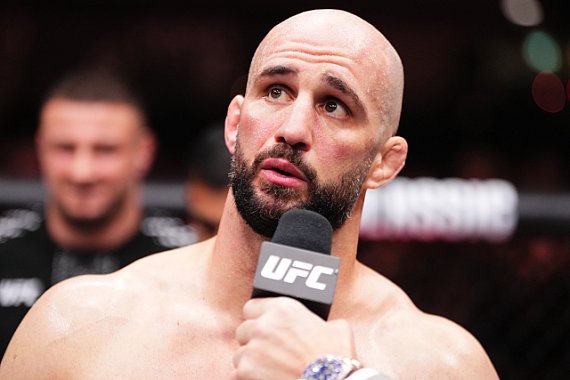
Perennial Ultimate Fighting Championship contender
Volkan
Oezdemir made a statement on Instagram
Friday revealing the news of his failed drug test. He does so prior
to any statements from the organization or its anti-drug testing
wing of Combat Sports Anti-Doping. In February, he failed an
out-of-competition test for EPO. The Swiss athlete assumed full
responsibility for his actions and explained in detail what took
place in this unusual situation. The UFC and CSAD have yet to
provide a public statement on the matter, but indicated to
MMA Junkie that they worked alongside the World Anti-Doping
Agency to review this matter.
Advertisement
The former light heavyweight title challenger will be out of action
for 16 months effective his failed testing date, with CSAD reducing
his suspension from 18 months, two years or greater due to his
alleged complete cooperation in handling the case. In his
statements, Oezdemir indicated that he was approached by someone in
the healthcare industry offering to improve his condition, and he
unwittingly took banned substances.
I cooperated immediately; I did the same with CSAD
Oezdemir’s complete
statement, written both in his native French and English with
bolded portions for emphasis, was accompanied by a caption. In the
brief caption, he wrote, “I have an announcement to make, and it’s
a difficult one. I made a mistake, and I’ll explain why in the hope
of helping other athletes.” The 205er’s statement reads as follows:
“In February, I tested positive for EPO after following the
recommendations of a healthcare professional. As an elite athlete,
I am responsible for everything I put in my body.
I made a mistake, and I take full responsibility for it.
“At the end of 2025, I competed in Qatar. A few days later,
I was contacted on Instagram by a healthcare
professional based in Switzerland. He introduced himself
as a supporter and suggested that we meet. During our first
meeting, he told me about his connections with influential people,
investment opportunities in one of the Gulf states, and potential
prospects for my career after retirement from the sport. He also
mentioned the possibility of patronage. I was 36 years old
and thinking about life after my sporting career, so I was
interested.
“I was recovering from ankle surgery. The
healthcare professional and I met again. The conversation
shifted. He no longer talked about business, but about my
recovery. He presented me with a plan that, according to him, would
get me back to peak physical condition within two months. He showed
me a substance that he described as safe and undetectable. He had
prepared a vial of EPO. He told me not to tell anyone about it. I
complied. I gave myself the first injection that same evening. That
was my decision. And it was the biggest mistake of my
life.
“Three days later, the Combat Sports Anti-Doping (CSAD) team came
to my home to conduct an anti-doping test. On March 5, I
was informed that my test had come back positive. In that
moment, the illusion was shattered, and my reality changed. But in
a way, it was also a relief.
“I decided to tell the UFC everything. I cooperated immediately. I
did the same with CSAD. In the end, I received a 16-month
suspension in light of my cooperation and the mitigating
circumstances: a healthcare professional played a
significant role; he initially approached me under the pretense of
discussing business; he had prepared the substances himself and
provided them to me free of charge.
“My independence has always been one of my strengths. I left home
at a young age to live abroad. I built my career far from my
family. I moved country to country to pursue my sport. I got used
to dealing with problems on my own. But this time, it
became a weakness. Today, I want to say to every
athlete—especially those competing in individual sports—that
isolation is a risk.
“I acknowledge what I did, and I take full responsibility for it.
Every athlete is responsible for what they put into their body. I
am sharing how this happened because I needed to understand my own
actions. And because what happened to me could happen to other
athletes. I let down my sport, my fans, and ultimately,
myself. To everyone who has supported me—my family, my
loved ones, and my supporters—I am deeply sorry.”